
About the Grant
A federal five-year effort to improve innovative charter school models and strengthen the authorizing systems that support them.
What is this initiative?
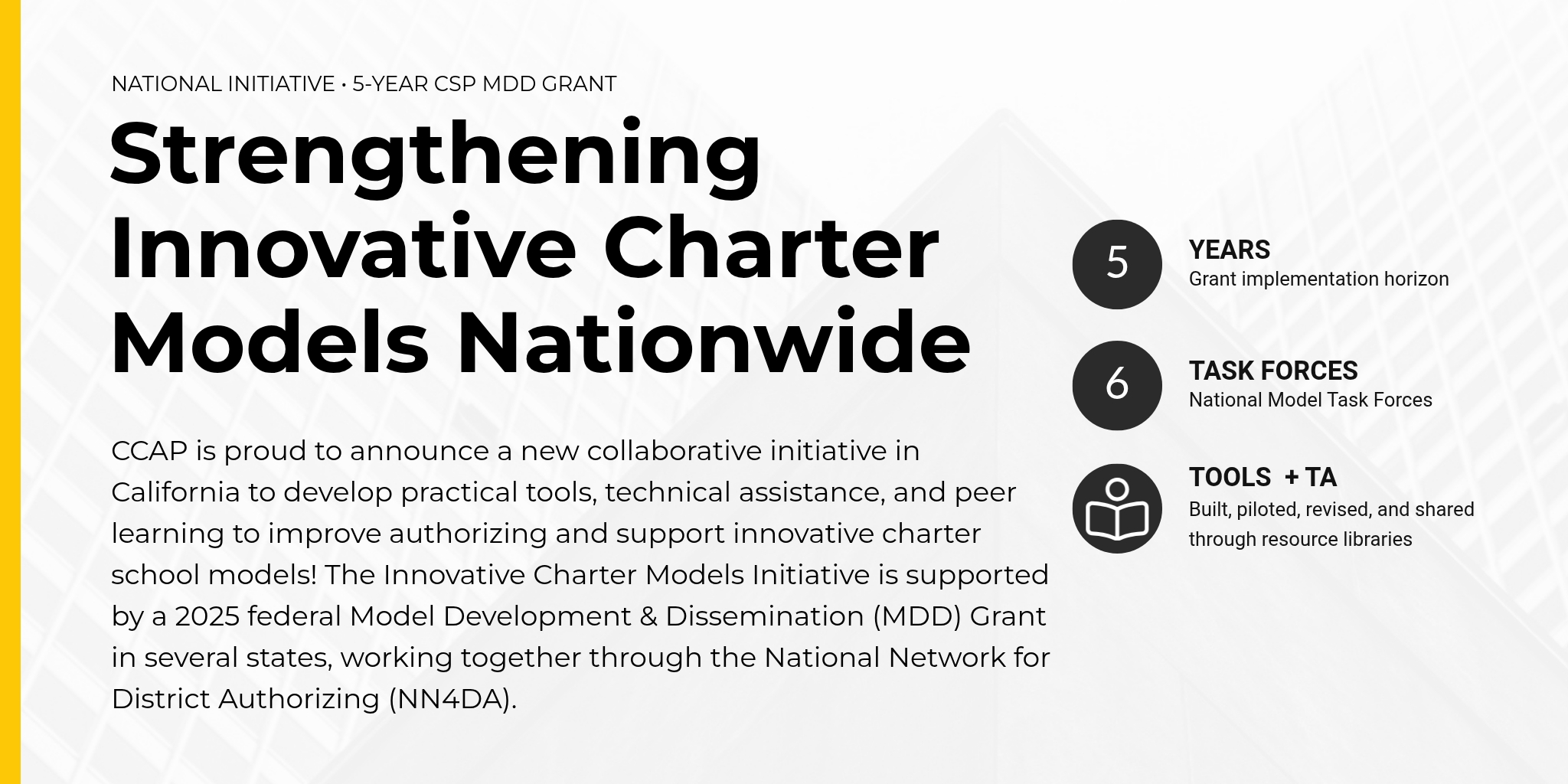
The Innovative Charter Models initiative is supported by a federal Charter Schools Program (CSP) Model Development & Dissemination (MDD) Grant won by the National Network for District Authorizing (NN4DA), of which CCAP is a founding member state partner. The initiative will strengthen innovative charter models and improve authorizing practices across the charter school lifecycle—from petition to pre-opening, oversight, and renewal. The purpose is not to promote these models, or more charter schools generally, but to help ensure that new schools can be approved that are innovative and fulfill public policy considerations.
Why this matters
Innovative models can face approval, opening, and operational barriers. Petitioners may not understand authorizer considerations and concerns. Authorizers may have limited capacity and tools for evaluating emerging models. This initiative addresses these challenges.
- Authorizer-informed model guidance
- Model-aligned authorizing guidance and evaluation protocols
- Burden reduction strategies (including AI applications)
- Support systems to help authorizers implement best practices
CCAP's Role
CCAP will lead the effort in California—organizing model-focused collaboration, producing guidance, and contributing to national tools and supports.
Lead & convene
Launch and support Model Task Force work, including convenings, facilitation, feedback loops, and documentation.
Build tools that work
Co-develop practical authorizing tools and implementation guidance; pilot and revise tools based on field feedback.
Support California authorizers
Deliver embedded support and connect California’s work to national learning through the NN4DA’s network of state initiatives.
Model Task Forces
A Model Task Force brings together authorizers, operators, and other experts to produce field-tested guidance and tools supporting the development of petitions that address public policy concerns for which authorizers have responsibliity, effective authorizer review of petitions to promote innovation while fulfulling this responsibility, and effective ongoing oversight and authorizing when petitions are approved.
What does a Task Force do?
-
- Identify model-specific barriers, opportunities, and public policy considerations
- Strengthen shared definitions and expectations
- Develop and pilot authorizing tools and implementation guides
- Use structured feedback for continuous improvement
What you’ll see produced
-
- Prioritized problem statements, considerations for addressing identified problems, and burden-reduction initiatives
- Piloted and revised guidance and tools
- Published toolkits and evaluation protocols
Technical Assistance
Built to be used—drafted, piloted, revised, and made accessible through CCAP’s free online Resource Library and shared nationally through the NN4DA.
Model-Specific Implementation Guides
Practical guidance to help developers and operators innovate while meeting public policy considerations and navigate approval, opening, oversight, and renewal.
Improved Authorizing Tools
Guidance and evaluation protocols designed to assess innovative models rigorously while respecting model differences.
Burden Reduction Supports
Strategies and technology-enabled approaches to reduce redundancy and improve oversight efficiency.
Project Goals
Three connected goals guide activities across Task Forces, technical assistance infrastructure, and national dissemination.
Goal 1
Improve the success of innovative model developers and operators by sharing well-tested and authorizer-informed resources and best practices.
Goal 2
Improve authorizers’ capacity to implement best practices that appropriately evaluate, oversee, and support innovative models.
Goal 3
Build and implement state-based and national authorizer technical assistance infrastructures to support innovation and high-quality processes.
Five-Year Timeline
A high-level roadmap—tools are developed, piloted, revised, disseminated, and sustained across the grant period.
Year 1
Year 2
Year 3
Year 4
Year 5
Get Involved
Connect with this work! Participate in Task Forces, access tools, and stay informed as new resources are released.
Want to participate or learn more?
Please contact CCAP to discuss Task Force participation, technical assistance opportunities, and how to access emerging resources.
Contact Tom.Hutton@calauthorizers.org for more information.
